
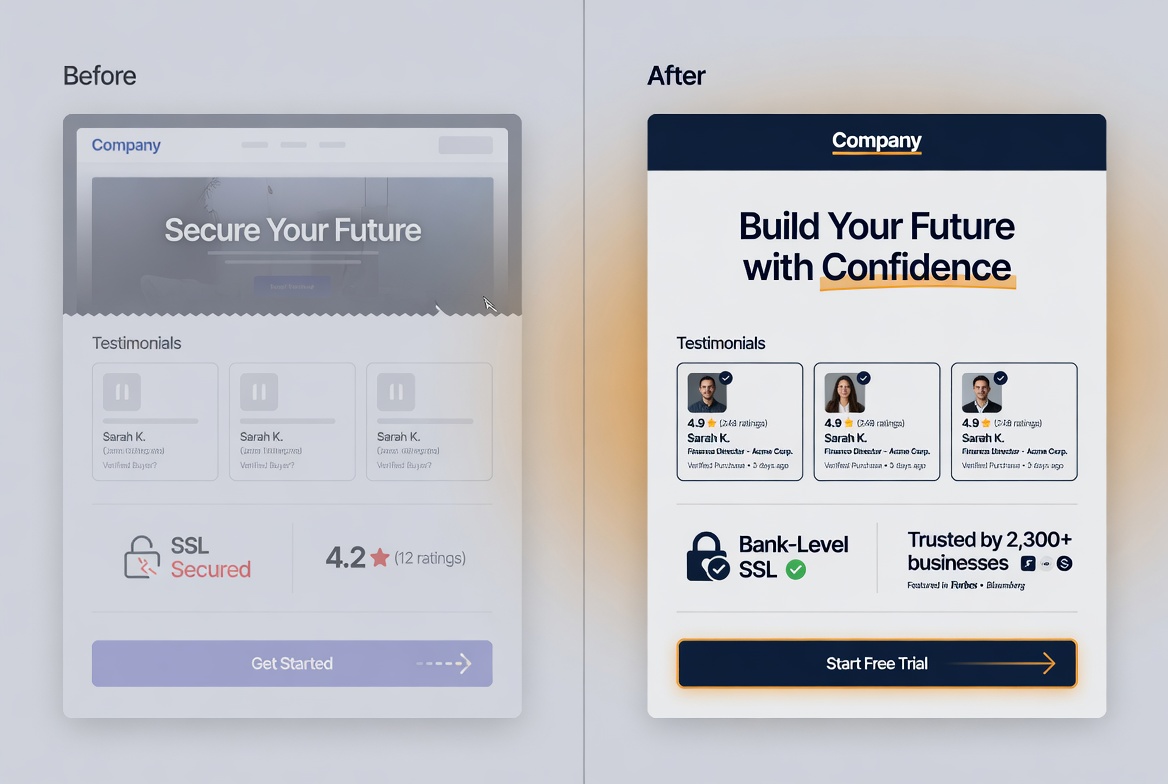
What Actually Changes After You Fix Trust Signals? (Real Before & After Examples)

What Actually Changes After You Fix Trust Signals? (Real Before & After Examples)

Many business owners understand intellectually that trust matters on their website. But a common and fair question remains: “If I actually fix these trust issues, what will really change?”

It’s one thing to talk about trust in theory. It’s another to see what actually moves when trust signals are strengthened.

Over the years, we’ve seen consistent patterns in what improves when businesses address weak trust signals on their websites. Here’s what typically happens.


What Usually Improves First

When businesses strengthen their trust signals, certain improvements tend to appear earlier than others. These are the changes we see most consistently:

  • Higher quality of inbound leads — Not necessarily more leads, but better ones who are more serious about moving forward.
  • Improved show-up rates for calls and meetings.
  • Faster movement through the sales process — Prospects make decisions more quickly.
  • Fewer “let me think about it” responses that lead nowhere.
  • Higher close rates on the leads they were already generating.

Importantly, these improvements often happen without changing the offer, pricing, or running significantly more traffic.


Before & After Examples

Here are three realistic examples of what changed after businesses addressed trust issues on their websites.

Example 1: Professional Services Firm — Higher Close Rate

Before:
A well-established professional services firm was generating a steady flow of qualified leads through content and referrals. However, their close rate was stuck around 18–20%. Many prospects would say the work “looked great” during initial conversations, but then go quiet or take weeks to decide.

What was fixed:
They strengthened their social proof with more specific, results-focused testimonials and case studies. They added clearer risk reversal language and made their process more transparent on the website.

After:
Their close rate increased to 27–30%. The average sales cycle shortened by roughly three weeks. Most notably, they didn’t need to generate more leads — they simply converted more of the leads they already had.

Key takeaway: Better trust signals helped serious prospects feel confident enough to move forward instead of defaulting to “let me think about it.”

Example 2: B2B Service Provider — Faster Decisions & Better Lead Quality

Before:
A B2B company offering high-ticket services was getting decent inbound interest. However, decision-makers consistently asked for more information, case studies, and reassurance during sales calls. The sales process felt slow and repetitive.

What was fixed:
They added stronger, measurable case studies with specific outcomes. They created a clear “How We Work” section and made guarantees and next steps more visible on key pages.

After:
A higher percentage of inbound leads were ready to engage seriously. The sales team reported that prospects asked fewer basic questions and moved through the pipeline faster. Average deal cycle time dropped noticeably.

Key takeaway: Stronger trust signals helped qualify serious buyers earlier and reduced the amount of hand-holding required during the sales process.

Example 3: Established Business With a “Good Enough” Website

Before:
An established company had a professional-looking website and consistent traffic. Their conversion rate had plateaued for years, and they assumed this was simply “the new normal” for their industry.

What was fixed:
They updated several outdated design elements, improved visual hierarchy, added more recent and specific social proof, and clarified their guarantees and process. None of these were massive changes — mostly refinements.

After:
Their conversion rate increased by 35–45% within 60 days. The biggest surprise was how many existing visitors (people who had visited before) started converting once the friction was reduced.

Key takeaway: Even websites that feel “good enough” can be leaving significant revenue on the table due to accumulated small trust gaps.


What Usually Doesn’t Change

It’s important to be honest about what fixing trust signals does not do:

  • It rarely fixes a fundamentally weak offer or poor positioning.
  • It doesn’t usually create massive, overnight jumps in conversion rate (for example, going from 2% to 10%).
  • It won’t compensate for bad traffic or an uncompetitive offer.

What it does do is remove unnecessary friction so that good marketing and a solid offer can perform closer to their actual potential.

This distinction matters. Fixing trust signals is powerful, but it works best when the fundamentals of the business are already reasonably strong.


Why These Improvements Happen

When trust signals are weak, even interested prospects carry hidden doubt. This doubt creates hesitation at the moment of decision.

When those signals are strengthened, several things happen:

  • Reduced risk perception — Prospects feel safer moving forward.
  • Increased confidence in the outcome.
  • Faster decision-making — People spend less time second-guessing.
  • Higher willingness to engage — Serious buyers move forward instead of disappearing.

The result is that more of the right people take action, and they do so more easily.


How Big of a Difference Is Realistic?

Results vary depending on how weak the trust signals were to begin with and how well the improvements are executed. However, here are typical realistic improvements we see:

MetricTypical Improvement
Conversion Rate20–50% lift
Close Rate15–35% improvement
Sales Cycle LengthNoticeably shorter
Quality of Inbound InquiriesHigher

These aren’t guaranteed numbers, but they represent the range of outcomes we commonly observe when trust signals are properly addressed.


The Bottom Line

Fixing trust signals on your website doesn’t replace good marketing or a strong offer. But in many cases, it unlocks significantly more value from the traffic and leads you’re already generating.

The improvements are usually measurable and meaningful — especially for businesses selling higher-ticket or considered services.

If you want to understand what’s possible for your specific website, the most practical next step is getting a professional audit of your current trust signals.

Explore Our Audit Options →

Or if you’d like to start with something lighter, you can get your free Trust Score to see where your website stands today.